
Exosome Hair Treatment vs PRP: Which Is Better?
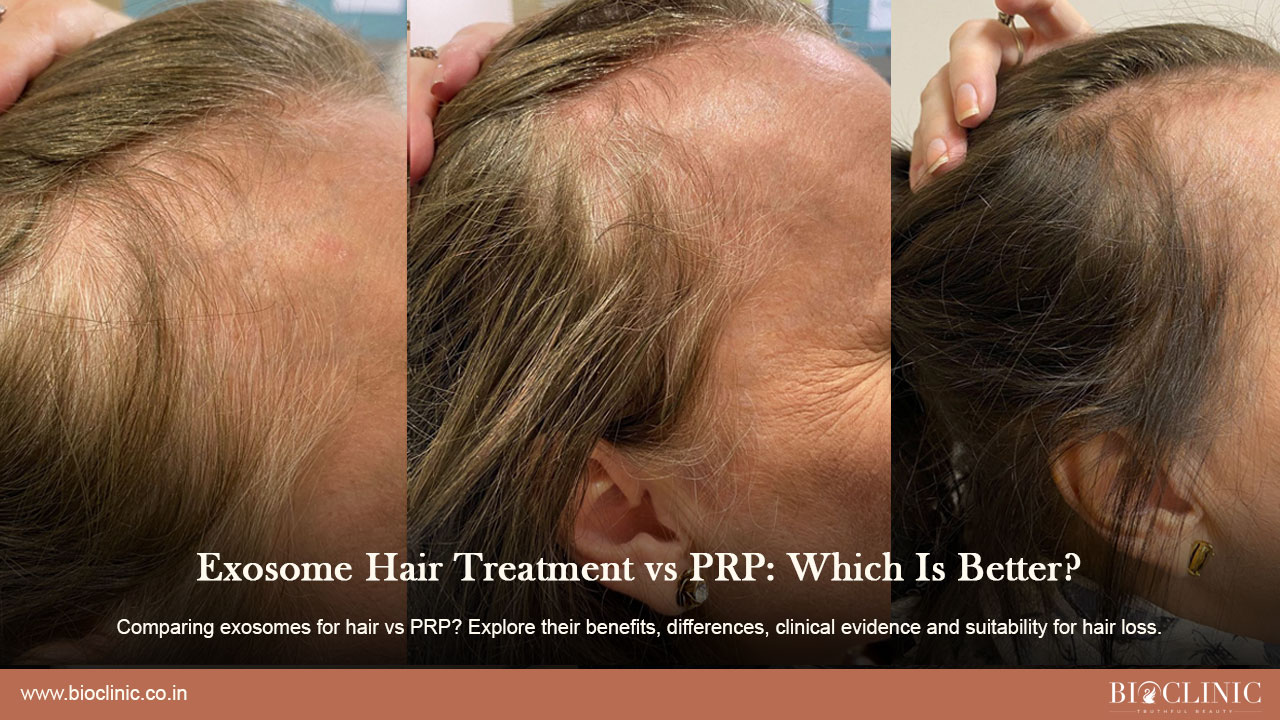
Hair thinning rarely happens overnight. It often begins with subtle changes: a widening hair parting, reduced hair volume, excessive shedding or strands that gradually lose their thickness. As people explore solutions for hair loss, two regenerative approaches increasingly enter the conversation: Platelet-Rich Plasma (PRP) and exosome hair treatment.
Both treatments aim to support the scalp environment and encourage healthier hair growth, but they work differently. While PRP uses growth factors derived from an individual's own blood, exosome therapy focuses on delivering biological signalling molecules that may influence communication between cells.
So, when comparing exosomes for hair vs PRP, which treatment is more suitable? The answer depends on the underlying cause of hair loss, follicular health, treatment expectations and the available clinical evidence.
Understanding PRP for Hair Loss
Platelet-Rich Plasma, commonly known as PRP, is a regenerative treatment prepared using the patient's own blood. A small blood sample is collected and processed through centrifugation to separate and concentrate platelets within the plasma.
These platelets contain growth factors, including PDGF, TGF-β and VEGF, which participate in tissue repair, cellular signalling and biological processes associated with hair follicle activity.
When introduced into the scalp, PRP aims to create a more supportive environment for existing hair follicles. It is commonly explored for androgenetic alopecia, a pattern of hair loss influenced by genetic and hormonal factors.
One of PRP's advantages is its comparatively established clinical evidence base. A systematic review published in the Journal of Cosmetic Dermatology examined nine studies involving 291 participants and found improvements in hair density and hair count in several trials.
However, PRP outcomes can vary. Platelet concentration, preparation methods, individual biological factors and the underlying condition can influence treatment response. Multiple sessions are generally considered, rather than expecting a change after one sitting.
What Is exosome hair treatment?
Exosomes are tiny extracellular vesicles released by cells. They act as biological messengers, carrying proteins, lipids and genetic material, including microRNA, which can influence how recipient cells behave.
Unlike PRP, exosome formulations are not prepared from the patient's own blood during the treatment session. They contain extracellular vesicles sourced and processed separately, with their composition depending on the manufacturing process and biological source.
In hair restoration research, exosomes are attracting interest because of their potential role in cellular communication around hair follicles.
Researchers are investigating whether these signalling molecules can influence dermal papilla cells, support follicular activity, regulate inflammatory responses and affect pathways associated with the hair growth cycle.
The central idea is that healthy hair growth involves more than the visible hair shaft. It also depends on the biological environment surrounding the follicle.
However, exosome therapy remains an emerging treatment. Early clinical findings are encouraging, but larger, well-controlled human studies are still needed to establish its long-term efficacy and standardise treatment protocols.
Exosomes for Hair vs PRP: What Are the Key Differences?
Although both treatments fall within the regenerative hair restoration category, their mechanisms and preparation differ.
1. Source and preparation
PRP requires a blood sample from the patient. The sample undergoes centrifugation to concentrate platelets before the preparation is introduced into the scalp.
Exosome treatment does not require drawing the patient's blood. The formulation is prepared separately and contains extracellular vesicles carrying biological signalling molecules.
This makes exosome treatment a potentially more convenient option for individuals who prefer not to undergo blood collection.
2. How they support hair follicles
PRP delivers concentrated platelets and their associated growth factors to the scalp. These growth factors participate in processes involved in tissue repair and follicular activity.
Exosomes are being studied for their ability to facilitate cell-to-cell communication. Their molecular cargo may influence several biological pathways involved in follicular function, growth signalling and inflammation.
This broader signalling potential is one reason exosome therapy has attracted attention in regenerative aesthetics. However, it has not yet been established that this translates into superior clinical outcomes compared with PRP.
3. Treatment consistency
PRP is an autologous treatment, meaning its biological material comes from the individual receiving it. Platelet concentration and preparation quality can vary between patients and treatment protocols.
Exosome formulations are manufactured separately. Their composition can also vary considerably depending on their source, isolation, purification and quality-control standards.
Therefore, consistency should not be assumed simply because a treatment is labelled as exosome therapy.
4. Treatment sessions and recovery
PRP generally involves blood collection, processing and scalp administration. It is commonly delivered over a series of sessions, with intervals determined by the practitioner.
At BioClinic, exosome treatment is delivered using a scalp-stamping technique. The approach is designed to introduce the formulation into the targeted scalp area without requiring blood collection. Some discomfort can occur during the procedure. There is currently no universally established exosome treatment schedule. The number of sessions and maintenance requirements depend on the formulation, delivery method and individual treatment plan.
Is Exosome Therapy Better Than PRP for Hair Loss?
Exosome therapy offers an interesting approach because of its potential to influence multiple cellular signalling processes rather than relying solely on platelet-derived growth factors.
Its appeal lies in the possibility of supporting the biological environment surrounding hair follicles, including pathways associated with growth and inflammation.
However, PRP currently has a longer clinical track record and a more established body of human research. Exosome therapy has promising early findings, but there are not enough robust head-to-head clinical trials to establish that it is more effective than PRP.
A 2025 systematic review of exosome-based hair restoration identified 11 clinical studies and reported improvements in at least one hair-growth parameter across the studies. Nevertheless, the researchers highlighted small sample sizes, differences in formulations and varying treatment protocols as important limitations.
The more accurate conclusion is that both treatments have potential, but neither is universally better for every individual.
Who May Benefit from Considering exosome hair treatment?
Exosome therapy may be worth discussing with a qualified practitioner for individuals experiencing early-to-moderate hair thinning, particularly when existing follicles are still present.
Some people who may seek an assessment include:
- Individuals experiencing progressive hair thinning and reduced hair density.
- People noticing changes in hair quality and volume.
- Women experiencing hair changes around perimenopause or menopause.
- Individuals experiencing hair shedding following illness or physiological stress, once the underlying cause has been evaluated.
- Those exploring regenerative approaches and looking for alternatives that do not involve drawing their own blood.
These are potential assessment groups, not established indications or guarantees of response. Hair loss caused by nutritional deficiencies, thyroid disorders, hormonal conditions, autoimmune disease or other medical factors may require different management.
A proper assessment of the scalp and the cause of hair loss should always come before selecting a treatment.
What Does Pretti Singh Recommend at BioClinic?
According to Pretti Singh, Aesthetician and founder of BioClinic, the appeal of exosome therapy lies in its approach to cellular communication.
She explains that while PRP delivers growth factors through the patient's own platelets, exosomes are designed to deliver biological signalling molecules that may influence the environment surrounding hair follicles.
She also highlights the practical distinction: exosome treatment does not require blood collection and is delivered at BioClinic through a stamping technique, which may involve some discomfort.
At BioClinic, treatment frequency is determined according to the individual's hair-loss concerns and response. The clinic's approach also considers ongoing home care rather than viewing an in-clinic procedure as a standalone solution. The treatment schedule described by BioClinic is a clinic-specific protocol, not a universally established clinical standard.
The BioClinic Perspective: Choosing the Right Hair Restoration Approach
When comparing exosomes for hair vs PRP, the decision should not be driven by which treatment is newer or more widely discussed.
The underlying cause of hair loss, the condition of existing follicles, the quality of the treatment formulation and individual expectations all matter.
At BioClinic, Kanpur, the approach to hair and scalp aesthetics centres on understanding individual concerns before recommending a treatment. Exosome therapy is one of the regenerative approaches offered through its hair-care services. For anyone considering the treatment, it is equally important to ask about the exosome source, product quality, preparation standards, delivery technique, realistic outcomes and potential risks.
Exosome therapy represents an interesting development in hair restoration research. PRP, meanwhile, continues to have a more established clinical evidence base. The best treatment is ultimately the one that is appropriate for the individual's hair-loss condition, supported by a transparent assessment and realistic expectations.
Frequently Asked Questions
1. Is exosome hair treatment better than PRP?
Not conclusively. Exosome therapy has promising early clinical evidence, while PRP has a longer history of research and clinical use. There is insufficient high-quality comparative evidence to establish that one is universally superior.
2. What is the main difference between exosomes and PRP for hair?
PRP uses concentrated platelets obtained from the patient's blood, whereas exosome therapy uses separately prepared extracellular vesicles containing biological signalling molecules. Their mechanisms and preparation methods differ.
3. Does exosome hair treatment require blood collection?
No. Exosome formulations are prepared separately, so the treatment does not require drawing the patient's blood. The delivery method varies between providers.
4. Who is a suitable candidate for exosome hair treatment?
People experiencing early-to-moderate hair thinning with existing follicles may be considered for assessment. Suitability depends on the underlying cause of hair loss, scalp condition and individual circumstances.
5. How many exosome hair treatment sessions are required?
There is no universally established number of sessions. Treatment frequency depends on the formulation, delivery technique, individual condition and practitioner's protocol.
6. Can exosome therapy permanently stop hair loss?
There is insufficient evidence to claim permanent hair restoration. Results vary, and progressive conditions such as androgenetic alopecia may require ongoing management.
About the Expert
Pretti Singh is an Aesthetician and the founder of BioClinic, Kanpur. With over three decades of experience in aesthetics and personalised skin and hair care, she advocates an individualised approach to understanding beauty and wellness concerns.

Updated on: 02 Nov 2026